TL;DR: Using AI to handle repetitive work is not automatically laziness, the same way hiring a virtual assistant never was. It becomes a problem when a person stops learning, verifying, or taking responsibility for the result. For Filipino students, creators, and founders with limited resources, AI can be a new layer of leverage, not a shortcut around doing the work.
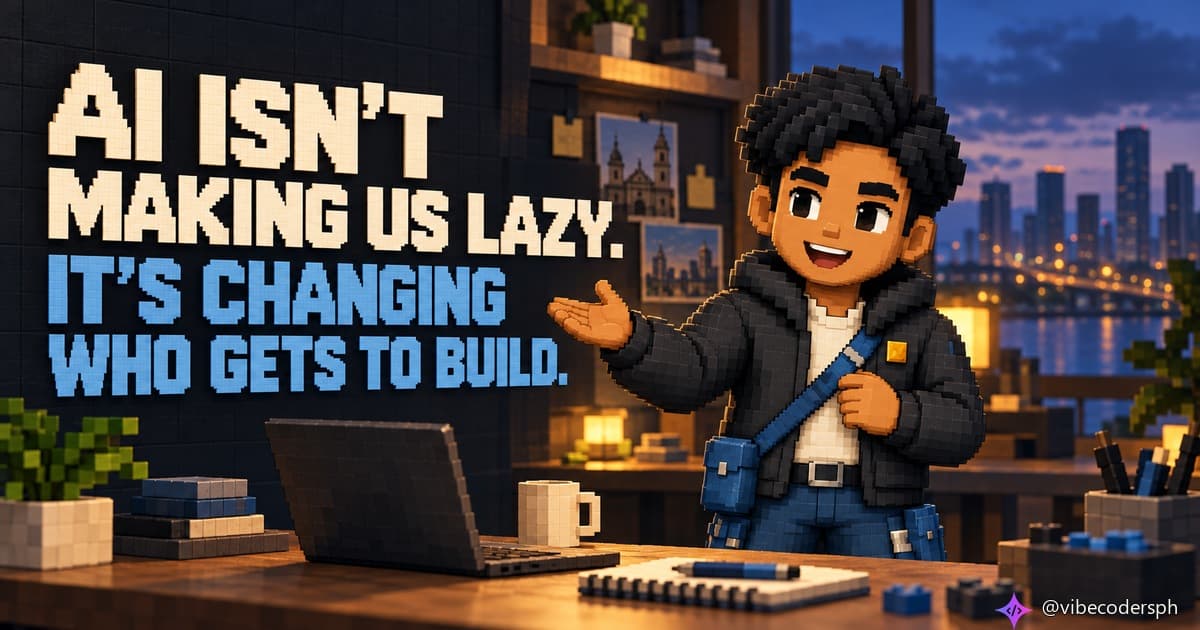
AI can make people less thoughtful when they use it to outsource judgment, learning, and responsibility. But using AI to handle repetitive work is not automatically laziness.
For Filipino students, creators, starting founders, junior developers, and people entering a new field, AI can be a new layer of leverage. It can lower the cost of doing the work enough that more people can create a project, test a business idea, or build a small company with limited resources.
The important question is not "Did AI help you do the work?" The important question is "What did you keep as a human?"
Why does AI use get framed as laziness?
People now use AI to schedule their day, compose emails, make posters, generate images, do research, write drafts, manage promotions, and automate repetitive workflows.
Sometimes that really does become avoidance. Someone can ask AI to think, write, and decide everything, then submit the result without understanding it. That is a real problem, especially for students and junior workers who still need to develop their fundamentals.
But the same tool can also remove work that is repetitive without being meaningful. A founder can use AI to organize a lead list, draft an email sequence, create a first version of a landing page, or generate design options. The founder still needs to know the customer, choose the positioning, judge the quality, verify the claims, and take responsibility for the result.
That is delegation. It is not automatically laziness.
What is the virtual-assistant comparison?
Here is the double standard I keep thinking about.
A small business owner, YouTuber, or influencer in the United States could hire a Filipino virtual assistant to manage email, social media posts, lead management, thumbnails, or video editing. We usually describe that as outsourcing or delegation. We do not automatically say the founder is lazy because another person handled the repetitive work.
Now a Filipino creator or founder uses an AI agent for some of those same tasks, and the first reaction is often: "Tamad na kasi umaasa sa AI."
The comparison is not perfect. AI agents are not human workers. They do not have a livelihood, lived experience, or human accountability. A virtual assistant and an AI agent should not be treated as interchangeable.
But the economic idea is similar: a person is trying to increase their capacity by handing repetitive work to another layer of execution. Before, that layer usually required money, employees, or access to a larger organization. Today, some of it can be accessed through an AI subscription or usage credits.
We should not reserve the word leverage for people who can afford to buy labor.
What should stay human?
The best AI workflow is not "AI does everything." It is a division of work.
| AI can help with | The human should still own |
|---|---|
| Scheduling and reminders | Priorities and tradeoffs |
| First-pass research | Source checking and interpretation |
| Draft emails and copy | The relationship and the decision to send |
| Design options and image variations | Taste, context, and the final choice |
| Code scaffolding and repetitive edits | Understanding, testing, security, and maintenance |
| Lead sorting and workflow steps | The customer problem and the business judgment |
If AI handles the repetitive layer while the person spends more cognitive load on the problem, the idea, the customer, the quality bar, and the next decision, that can be a good use of the tool.
If AI is being used so the person never has to learn, verify, or take responsibility, that is where the lazy criticism becomes useful.
Why does this matter more for the Philippines?
I think AI is political because it changes who can access productive capacity.
High-income countries still dominate AI models, compute infrastructure, and startup funding. The World Bank's Digital Progress and Trends Report 2025 also says that developing countries can adapt existing and open-source AI to local economic, cultural, and institutional contexts, but that inclusive progress depends on connectivity, compute, context, and competency. Read the report.
This does not mean AI automatically solves the development gap. It does mean the Philippines does not have to wait until every local company has a huge technology budget before experimenting with useful systems.
The Philippine Institute for Development Studies reported in a December 2024 study that 14.9 percent of firms used AI technologies, with adoption concentrated among larger and urban firms, particularly in ICT and BPO. That is a sign that adoption is still early and uneven, and that capability building matters. Read the PIDS study.
The Department of Science and Technology has also described a Philippine AI strategy focused on infrastructure, workforce, innovation, ethics and policy, and deployment, with applications across agriculture, education, smart cities, and creative industries. Read DOST's overview.
The opportunity is therefore not simply to consume tools made somewhere else. It is to use available tools to build local knowledge, local workflows, local products, and local companies, while also developing the infrastructure and skills that keep more value in the country.
Will AI remove the need to learn?
AI can help a small team move faster, but it can also produce wrong answers, insecure code, generic writing, fake confidence, and work that nobody can maintain. A person who cannot explain what the AI produced is not automatically an AI-native builder. They may simply be dependent on a system they cannot inspect.
The goal is not to avoid learning. The goal is to learn while building.
- A student can use AI as a tutor, but should still solve problems and explain the answer.
- A junior developer can use AI for scaffolding, but should still read the code, test it, debug it, and understand the system.
- A creator can use AI for production tasks, but should still own the point of view, taste, story, and relationship with the audience.
- A founder can use AI to stretch a small team, but should still talk to customers and decide what deserves to exist.
What is the window for Filipino builders?
For many Filipinos, the old path to building something valuable required resources that were difficult to access: a team, a large budget, specialized software, a technical co-founder, or enough free time to do every task manually.
AI does not remove all of those constraints. But it can reduce the cost of some of them.
That matters for the starting founder who is still working full-time. It matters for the creator who cannot yet hire an editor. It matters for the student who needs feedback while learning. It matters for the small team trying to make a tool for a Philippine school, cooperative, local business, or public service.
The next question is whether we use that access only to make ourselves more efficient employees, or whether we also use it to build something of our own.
So when someone says AI is making Filipinos lazy, my answer is: sometimes, maybe. We need to be honest about that. But that is not the whole story.
For Filipinos with high hopes, limited resources, and something they want to build, AI may be less like an escape from work and more like a chance to finally do the work at a larger scale.
Use it to learn faster. Use it to remove repetitive work. Use it to make more room for judgment, taste, and imagination.
Then build something that could not have existed before.
Frequently asked questions
Is using AI automatically lazy?
No. Using AI to remove repetitive work is not automatically lazy. It becomes a problem when a person gives up learning, judgment, verification, or responsibility.
Are AI agents the same as Filipino virtual assistants?
No. They are not equivalent. The comparison is about access to leverage: both can be used to delegate some repetitive tasks, but human workers bring context, judgment, livelihood, and accountability that AI does not.
Can AI help the Philippines catch up?
It can create an opportunity, but it is not a guarantee. The Philippines still needs skills, affordable connectivity, compute, local data and context, responsible policy, and people who can turn prototypes into reliable systems.
What should Filipino builders learn first?
Learn how to identify a real problem, use AI tools, verify outputs, understand the underlying work, protect data, and ship something that another person can actually use.
Sources
- Digital Progress and Trends Report 2025, World Bank, 2025.
- AI adoption among Philippine firms, Discussion Paper Series No. 2024-35, Philippine Institute for Development Studies, December 2024.
- DOST builds on AI national strategy, Department of Science and Technology, 2025.
Written by Viron Gil Estrada, founder of Vibe Coders PH.