

Short answer: Model Context Protocol (MCP) is an open-source standard, announced by Anthropic in November 2024, that lets AI applications connect to external tools, data sources, and workflows through one common interface instead of a custom integration for each one. I found it while trying to research my interviewers without LinkedIn notifying them, by connecting Claude Desktop to a web-data MCP server.
Job hunting is a journey full of small strategies and hidden tools. Every detail matters: the company research, the role, and, of course, the people who will sit across the table and decide your future. That's why, like many of you, I don't just prepare answers, I prepare for who I'll be answering to.
Recently, while navigating interviews, I stumbled on a problem that opened my eyes to a technology called Model Context Protocol, or MCP.
The dilemma: researching people without being seen
Picture this: I had just received an email with the names of my upcoming interviewers, the recruiter and the hiring manager. Naturally, I wanted to learn more about them: their background, their style, their career trajectory. This context can make the difference between a surface-level conversation and one where you truly connect.
My first instinct was to search for them on LinkedIn. But here's the catch: LinkedIn notifies users when you view their profile (unless you're browsing in private mode, which hides your identity but also hides most of what you'd want to see about them). That's fine if you're networking casually, but in a high-stakes interview scenario, the last thing I wanted was for the recruiter or hiring manager to know I was studying their profile the night before. So I looked for another way to gather insight without leaving a footprint.
The discovery: what MCP actually is
In my search for a solution, I found Model Context Protocol. MCP is an open-source standard, introduced by Anthropic in November 2024, for connecting AI applications to external systems: data sources like local files or databases, tools like search engines or scrapers, and workflows like specialized prompts. Anthropic describes it as something like a USB-C port for AI applications: one standard connector instead of a custom integration for every tool.
Instead of an engineering team wiring up a bespoke integration for every API an AI assistant might need, an MCP server exposes a fixed set of capabilities, and any MCP-compatible client, Claude, and others, can plug into it the same way.
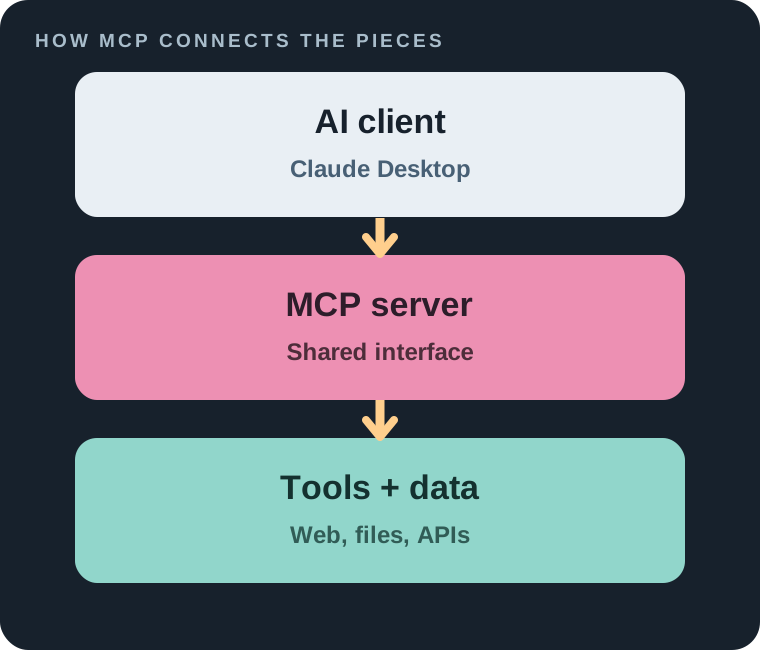
That's when I found out Bright Data has an official MCP server that can plug into Claude Desktop and give it structured access to public web data.
The practical application: Bright Data MCP + Claude
Here's what I set up: Claude Desktop as my AI assistant, connected to the Bright Data MCP server, a tool that can fetch data from the web in a structured way.
The setup lives in Claude Desktop's config file (claude_desktop_config.json), where you register the server under mcpServers:
{
  "mcpServers": {
    "brightdata": {
      "command": "npx",
      "args": ["@brightdata/mcp"],
      "env": {
        "API_TOKEN": "your-brightdata-api-token"
      }
    }
  }
}
Once that's saved and Claude Desktop is restarted, Claude can call the server's tools directly. What this meant in practice: I could ask Claude something like "tell me about this recruiter's career history and recent role," and it would use the connected tool to pull that information back into the conversation, without me clicking through to their profile myself.
Why this matters for job seekers
This is more than a hack, it's a shift in how we can prepare for professional opportunities.
Confidence. Going into an interview already knowing who you'll speak to, what roles they've held, what industries they've touched, lets you tailor your conversation in a way that feels natural and informed.
A fairer playing field. Recruiters and hiring managers often research candidates extensively before interviews. There's a reasonable case for candidates doing the same, within a platform's terms and without misrepresenting themselves.
MCP isn't just for developers. It's infrastructure. Once a server exists for a given tool or data source, using it doesn't require you to write integration code.
The bigger picture: MCP beyond job hunting
Once I saw MCP in action, it became clear this is bigger than one use case. Researchers can pull structured insight from academic databases, journalists can gather structured information instead of manual searching, sales teams can research prospects before calls. MCP makes context-aware AI possible: an assistant that isn't limited to a model's static training data. It turns an assistant into something that can work with real-time data, through a tool built for that purpose, rather than the model guessing.
Final thoughts
That late-night scramble to prepare for an interview introduced me to one of the more useful shifts happening in AI right now. MCP isn't just for coders, it's for job seekers, researchers, and anyone who needs a smarter way to interact with the digital world. If you're mid job hunt, don't just polish your resume. Look at the tools that can give you an edge. For me, it was Bright Data's MCP server plus Claude Desktop, and it changed how I prepare.
Frequently asked questions
What is Model Context Protocol in one sentence?
MCP is an open standard, introduced by Anthropic in November 2024, that lets AI applications connect to external tools, data, and workflows through a common interface instead of a custom integration for each one.
Do I need to know how to code to use an MCP server?
No. You need an MCP-compatible client, like Claude Desktop, and a config entry pointing to the server. The people who write MCP servers need to code; the people who use them through a client generally don't.
Is MCP only for Claude?
No. MCP is an open protocol with client support across multiple AI applications and editors, including Claude, ChatGPT, and tools like Cursor and VS Code, plus a growing directory of both official and community-built servers.
Is it against LinkedIn's rules to research someone this way?
Automated scraping of LinkedIn data can run into LinkedIn's own terms of service, separate from whether MCP itself is doing anything wrong. Treat any web-data MCP server the way you'd treat a browser extension that touches a platform you don't control, and check that platform's terms before relying on it for anything high-stakes.
Where do I find MCP servers to connect to?
Anthropic and the community maintain a directory of official and community-built servers on GitHub, covering everything from filesystems and databases to web search and browser automation.
Sources
- What is the Model Context Protocol (MCP)?, Model Context Protocol documentation.
- Introducing the Model Context Protocol, Anthropic, November 25, 2024.
- Connect to local MCP servers, Model Context Protocol documentation.
- Model Context Protocol servers directory, GitHub.
- Claude Desktop Integration, Bright Data documentation.